
A Decade of Own Goals
Every successful founder makes peace with bad odds. What they can't plan around is a government that changes the rules mid-hand. Ten years, seven prime ministers, two U-turns on one tax in a month. The result: businesses that won't hire, won't invest, and increasingly won't stay.
Ten years of changing the rules has done more damage to British growth than any rule ever did.
Every successful entrepreneur I know is a gambler at heart. Not reckless, but thinking that they have a way to beat the odds. Most new businesses fail, they know it, and they sit down at the table anyway.
What nobody signs up for is a dealer who changes the game mid-hand. You place your bet on the set of rules in front of you, before suddenly being told the winner is closest to 25, not 21. You wouldn’t play a game like that, so why would you run your business like that?
I think that is the real reason Britain cannot grow. We spend all our energy arguing about what the rules should be:
- Tax up or down,
- more red tape or less,
- this relief or that threshold.
Almost nobody argues about the thing that does the real damage, which is that the rules never stop moving. And we are about to do it all again. Within weeks the country will have its seventh prime minister in ten years, walking in with a fresh set of bold ideas and no general election to slow any of it down.
Risk is fine. It's uncertainty that kills you
The economist Frank Knight drew the line in his 1921 book Risk, Uncertainty and Profit. Risk is when you do not know the outcome but you do know the odds. You can price it, insure it, plan around it. Uncertainty is when you do not even know the odds. It cannot be priced, because there is no distribution to price against.
Starting a business is risk. It is the blackjack table. You can study the game, improve your chances, and place an informed bet. When government changes the rules after you have committed, it turns that risk into uncertainty. And the rational response to uncertainty is not to be brave. It is to wait. You delay the investment, you hold off on the hire, you sit on your hands until the picture clears. Caution in that situation is not cowardice. It is the only sensible move on the board.
Uncertainty has a number
There is hard evidence for exactly how much uncertainty costs. The Bank of England estimated that business investment was around 11% lower by the middle of 2019 as a direct result of Brexit uncertainty. This is even before a single thing had changed about Britain's trading relationship with anyone (Bank of England, Monetary Policy Report, November 2019). Absolutely nothing had happened yet. The not knowing alone was enough to knock a tenth off business investment.
This is measurable enough that economists built an index of it. The Economic Policy Uncertainty Index tracks precisely this (Baker, Bloom and Davis). Uncertainty has a quantity, and a price.
The British uncertainty number
The Office for Budget Responsibility's own figures show that output per person is roughly where it was in 2019. If the pre-financial-crisis trend of around 2% a year had simply continued, real GDP per person would be about 30% higher today (OBR, Economic and Fiscal Outlook, March 2026). A third of the country's prosperity missing.
The recent detail is no better. Productivity growth was downgraded again at the November 2025 Budget, from 1.3% to 1% a year (Institute for Government, November 2025). Business investment fell 2.5% in the final quarter of 2025 (ONS, Business investment in the UK: October to December 2025). And when the OBR explained why it expects business investment to stay weak, the first reason it gave was:
"continued weakness in business sentiment" (OBR, November 2025).
That is the official, carefully worded version of a dealer who won't stop changing the rules.
Ten years of moving the goalposts
There isn’t a single point of failure either. Spread the last decade out and you can see the problem is endemic. The churn happened under the Conservatives, it happened under Labour, and it happened whichever direction the change was pointing. Uncertainty has become the foundation of how Britain is governed.
Start with the biggest rule change of the century and the purest example of everything I am describing. Brexit was not only a change to the rules, it was years in which nobody knew what the rules were going to be. Deal or no deal. Which customs arrangement. What would happen to the EU workers already here. What the trading relationship would even look like on the other side. That is Knightian uncertainty in its most complete form and it lasted for years, not quarters.
In the nine quarters before the referendum, UK business investment grew in line with the rest of the G7. In the nine quarters after it, UK business investment grew by less than 2%, while every other G7 economy grew by more than 6% (Office for Budget Responsibility, 2018). The moment the rules became unknowable, investment stopped. And the gap never really closed. By 2023/24 UK business investment was still running around 12% below where the path of comparable economies says it should have been (UK in a Changing Europe, December 2025). One big unresolved rule change punched a hole in the country's productive capacity that is still open a decade on.
Covid is the one time in the whole decade when constant rule-changing was justified. There was a real emergency. Rules on trading, gathering and working sometimes had to move weekly because the situation itself was moving that fast. But the churn was already there in the Brexit years before Covid, and it’s still carrying on today. If anything, the pandemic embedded governing by constant change into our psyche so we treat every autumn like an emergency, moving the rules as though there were a crisis to justify it.
Take corporation tax as an example. A rise from 19% to 25% was announced in 2021, to take effect in April 2023. It was then cancelled in the September 2022 mini-budget. Three weeks later it was reinstated (House of Commons Library). Two U-turns on the same tax inside a month. If you were trying to decide whether to invest that autumn, which number were you supposed to plan against?
The IR35 off-payroll rules went the same way. They were extended to the private sector in April 2021 (HMRC), repeal announced in the September 2022 mini-budget (House of Commons Library), and that repeal was cancelled a month later (House of Commons Library).
The costs keep climbing alongside the reversals. The rules for investment shifted from the super-deduction to full expensing to a cut in the writing-down allowance from 18% to 14% from April 2026 (ICAEW, November 2025). Employer National Insurance rose from 13.8% to 15%, and the threshold at which employers start paying it was cut from £9,100 to £5,000, both from April 2025. For a worker on £20,000 that is a 50% increase in the employer's bill (Deloitte). Then dividend tax rose by two percentage points from April 2026, landing on the owner-managers who pay themselves that way (ICAEW).
And the sharpest illustration of all needed no change whatsoever. In the weeks before the November 2025 Budget, a rise in income tax was floated, briefed and debated, then abandoned on 14 November (ITV News, 14 November 2025). Nothing was legislated. The speculation alone was the cost, because for weeks every household and every business had to plan for a tax that never arrived.
Put yourself in the shoes of someone who started a business in 2016, the year the referendum landed. Since then they have watched almost every rule that touches them move. Several moved more than once. Some were announced and then unwound before they ever took effect. All of it brackets a pandemic that taught government to treat moving the rules as normal. You cannot build a five-year plan on ground that shifts like that. So you build a one-year plan, or you build nothing.
So who is left to start a business?
When the rules move like this, only one kind of business can still get off the ground: the one with almost nothing at stake that can start in a weekend and stop just as fast. And Britain has quietly become a nation of exactly those.
At the start of 2025, 75% of UK businesses employed nobody but the owner. That is around 4.3 million out of 5.7 million (Department for Business and Trade, Business Population Estimates 2025). While this stat is not new, the direction of travel is. Between 2024 and 2025, the number of businesses that employ someone fell by around 9,000, while the number employing nobody rose by more than 200,000 (Department for Business and Trade). The employer base is shrinking while the solo base swells. The House of Commons Library puts it plainly: changes to the business population have "largely been driven by changes in the number of solo self-employed people" (House of Commons Library).
Not only is planning and investment hamstrung by the uncertainty, but the rule changes that are implemented specifically target those looking to grow. In the last two years the taxes that have changed increased: employer National Insurance, the minimum wage, the risk of hiring under new employment law. Every one of those is a tax on employing a human being. The one-person business dodges all of it. The friction has been aimed with some precision at exactly the businesses that create jobs, and it has left the ones that do not almost untouched. The government's own survey confirms the effect. In 2024 the share of small employers growing their headcount fell by five percentage points while the share cutting jobs rose by five, leaving employers as likely to be shrinking as growing. And when those same employers were asked what was blocking their success, the answer had changed: taxation, National Insurance and business rates jumped sixteen percentage points in a single year to become the most cited obstacle, overtaking energy prices (Department for Business and Trade, Longitudinal Small Business Survey 2024).
An economy of one cannot grow
The mass of small businesses aren’t the ones that create jobs and therefore growth. The UK study from Nesta confirms job creation comes from a tiny sliver of fast-growing businesses. Among firms with ten or more employees, just 6% qualified as high-growth. Those 11,500 or so businesses created 54% of the new jobs that established firms of that size added in the three years to 2008 (Nesta, The Vital 6 Per Cent, 2009). The follow-up study found the pattern held straight through the financial crisis, with high-growth firms generating half of all new jobs among businesses of ten or more employees between 2007 and 2010 (Nesta, Vital Growth, 2011). More than half the country's job creation, from six firms in every hundred.
And the odds of a solo business ever joining that engine are vanishingly small. Nesta's follow-up traced the 221,731 businesses founded in 1998: two-thirds had vanished within ten years, and of the survivors only one in ten had grown to more than ten employees (Nesta, Vital Growth, 2011). Britain is busily optimising for the businesses that will almost never employ anyone, and taxing the ones that might or do. The formation figures are already bending to match. The rate at which new businesses are born has slipped from 13.0% in 2019 (ONS, Business births, deaths and survival rates) to 11.1% in 2024 (ONS, Business Demography 2024), and in 2022 more businesses died than were born for the first time since 2010 (ONS, Business Demography 2023).
The trap that feeds itself
What makes uncertainty so dangerous is that it’s a cancer that compounds. Economists even have a name for it: an uncertainty trap. A study of Mexico's decision in 2018 to cancel a half-built airport found that one impulsive government move triggered uncertainty and falling investment that fed on each other, knocking between 3.3% and 4.5% off GDP inside a year (CEPR, October 2024). A single decision, and a self-reinforcing spiral.
You can watch the loop close in Britain. Uncertainty weakens growth. Weak growth leaves people poorer and more frustrated. Frustrated people reach for disruptive politics that promises to tear things up and start again. Disruptive politics produces erratic, short-term policy. And erratic policy is simply more uncertainty, feeding straight back into the top of the loop. The evidence runs both ways round the circle. Higher economic uncertainty measurably increases support for populist parties across Europe (study of 24 EU countries, 1980 to 2020). And once in power, that style of politics generates still more of it. As the Carnegie Endowment puts it, "personalized, often centralized government decision making yields unpredictable policies, increasing uncertainty and risk" (Carnegie Endowment, 2023).
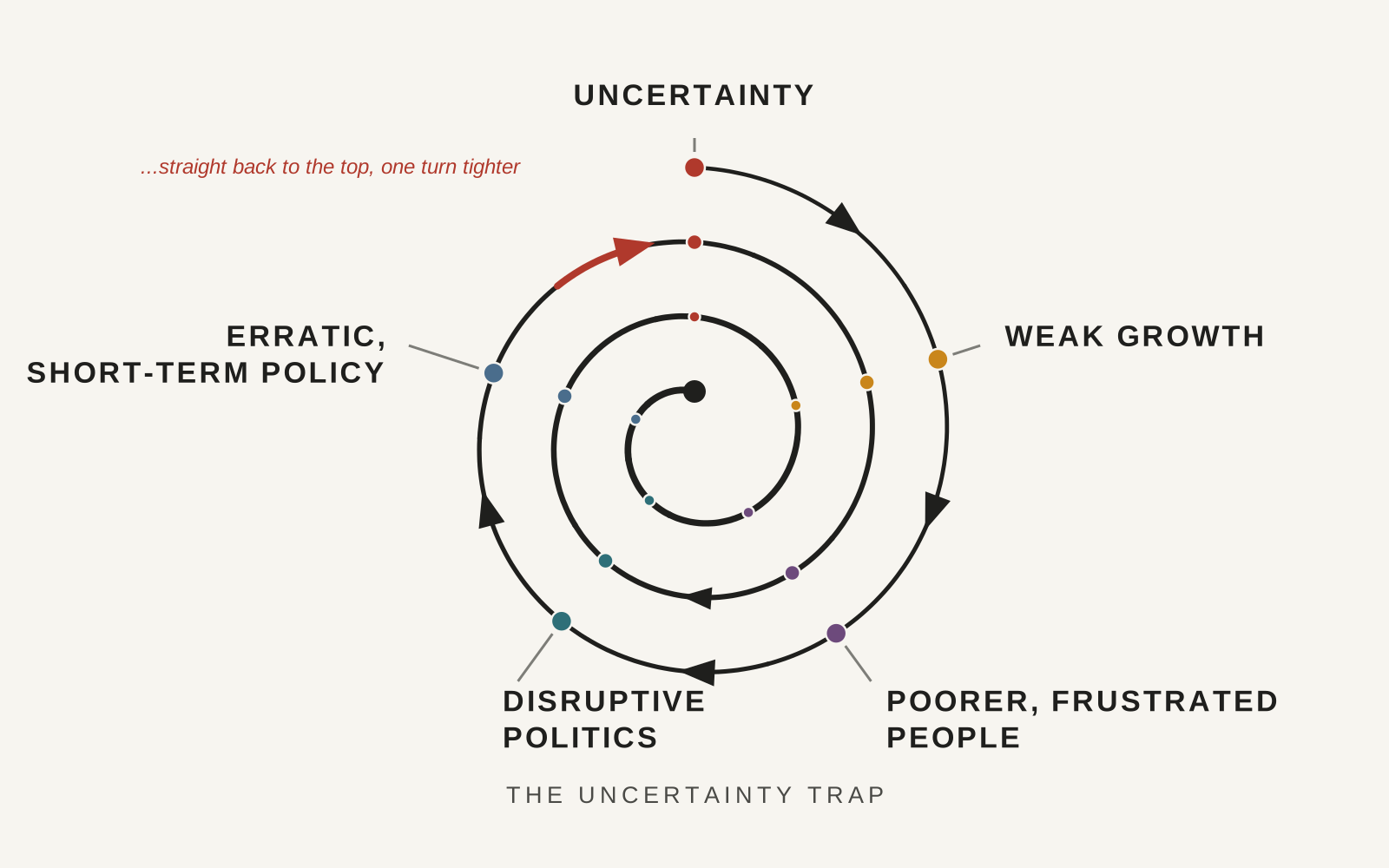
So this is not a one-off cost you absorb and move past. It is a cycle that gets worse each time round, unless something breaks it.
Here we go again
Which brings us back to the table, and to the seventh prime minister in ten years about to take a seat at it. No general election, no vote from the public, just a new leader with a new set of bold, radical ideas about how to fix growth. The bitter irony is that politicians reach for big, transformative change precisely because growth is weak. But big, transformative change is itself one of the biggest reasons growth is weak. They keep pouring petrol on the fire because the room feels cold.
The people who can leave, do. When the dealer keeps changing the rules, the rational move is to get up and find another table. Increasingly, that is exactly what is happening. In 2024 the London Stock Exchange lost 88 companies to delistings and moves elsewhere, against just 18 new arrivals. That is the biggest outflow since the financial crisis (EY, reported by AJ Bell, January 2025). Wise, Flutter and Ashtead are among those that have gone or are going, many of them towards New York. Not all of it is about tax or rule changes; some is about deeper capital markets and higher valuations. But the pattern is hard to miss. The businesses with the means to move are moving.
And there is a quiet tragedy in that. The people who leave are the mobile and the ambitious, the ones who might have built the business that employed a hundred others. What stays behind is what cannot move. A country that keeps changing its own rules does not just slow its growth. It exports the very people who create it.
So what fixes this? Stop mucking about with everything at once. Cut the number of rules, because every rule is one more thing a future budget can move. Simplify what remains, because a simple rule is easier to leave alone and easier to plan around. And when a rule genuinely has to change, change that one rule gradually, then watch what happens before you touch the next. Everything in an economy is connected, so a budget that changes ten things at once teaches you nothing about any of them. Change one, and you learn what it actually does. Rule by rule, the country becomes a table worth sitting down at again.
Until then, a bad rule is a known entity. You can price it, plan around it, build a business in spite of it. Uncertainty gives you nothing to build on at all. A predictable bad rule does less damage to growth than an unpredictable good one. Certainty is the policy. Everything else is detail.
Subscribe to Workplace Economies
Subscribe to be the first to know about new episodes and articles.
No spam. Unsubscribe anytime.
We collect your data in line with our privacy policy.